Open for participants
Many Analysts Psychedelic Project (MAPP)
Psychedelic experiences are measured with a patchwork of questionnaires — the Mystical Experience Questionnaire, the Challenging Experience Questionnaire, the Ego Dissolution Inventory, the 11-Dimensional Altered States…
About this study
Psychedelic experiences are measured with a patchwork of questionnaires — the Mystical Experience Questionnaire, the Challenging Experience Questionnaire, the Ego Dissolution Inventory, the 11-Dimensional Altered States of Consciousness scale — each of which builds in an assumption about how the experience is organised. Whether those assumptions carve the experience at its joints, and how far the answer depends on who does the analysis, remains an open question.
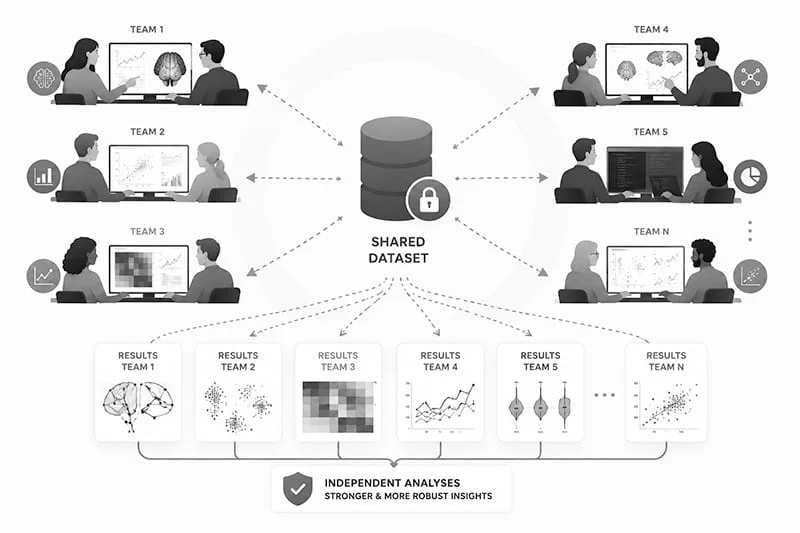
MAPP tackles this with a many-analysts design: independent teams analyse the same data using their own preferred methods, so that the robustness of a conclusion can be separated from the choices made to reach it. Three online samples of roughly 1,200 participants each described their most memorable psychedelic experience and rated it on 106 items drawn from the four scales. The samples differ in how those items were presented — grouped by questionnaire in their original response formats, or intermixed in random order with uniform absolute (“None” to “Extremely”) or relative (“Not more than usual” to “Extremely more than usual”) anchors. Measurement format is treated as a variable of interest rather than a nuisance.
Teams address three preregistered questions: what structure the subjective-effects data support, which aspects of the experience track self-reported dose, and how classic psychedelics can be distinguished by their subjective effects.
Our own contribution uses psychometric network analysis, modelling the 106 items as nodes linked by partial correlations rather than as indicators of latent factors. In the first dataset this points to a graded, overlapping continuum rather than a set of discrete dimensions: the clusters that emerge cut across questionnaire boundaries and fall short of the preregistered modularity threshold. Dose sits at the periphery of the network, connected selectively to intensity-related items such as vivid imagery and loss of the sense of time, and separately estimated networks for psilocybin and LSD do not differ in overall connectivity. Analyses of the two randomised-format datasets are ongoing.
All materials, hypotheses and analysis plans are preregistered on OSF (osf.io/hjx84; osf.io/xncdf).
Michiel van Elk & Daan Langeveld, PRSM Lab, Leiden University, in collaboration with David Yaden (Johns Hopkins University).
How to take part
Get in touch and we will tell you how to take part.
Part of

Scale Development
We are actively involved in developing, revising, and translating several psychometric scales.